Saturday, June 4, 2016

Structures Promoting Social Cohesion, Marx & Durkheim Comparison by Cassie Kinney

Structures Promoting Social Cohesion, Marx & Durkheim Comparison 
In works by Durkheim and Marx, it is apparent that both believe social structures-- that have been reproduced throughout generations-- are controlling individuals' behaviors. Because of this idea of control and power, Marx and Durkheim similarly were concerned with the emergence and convergence of capitalism. However, Durkheim saw the division of labor as necessary for social cohesion, while Marx believed the division of labor contradicts social cohesion. Another difference is that Marx believed people were naturally good and society is naturally harmonious, while Durkheim believed people needed to be regulated. Although Durkheim seems to be apologetic to the status quo, and it seems that Marx was concerned about the well-being of society's members, both agreed that it is society's responsibility to assist the needs of all members.  
Subsequently, both theorists believes that social structures-- that have been reproduced throughout generations-- are controlling individuals' behaviors. For example, Durkheim is quoted "I fulfill obligations which are defined in laws and custom and which are external to myself and my actions...I have received [duties] through education" (Longhofer & Winchester, 2012, pp. 7.) Durkheim believed the social facts, ways of thinking, acting, and feeling, that are external to us, making us capable of acting or restricting our action. These social facts include norms and values taught within school, language, religion, and law. Marx certainly agreed, and may call these social facts the "modes of production", and that these modes uphold the "the ideas of the ruling class" because the ruling class owns the material force of society. Thus, "the class which has the means of material production at its disposal, has control at the same time over the means of mental production" (Longofer & Winchester, 2012, pp. 118.) In other words, both theorists perceived the power of the capitalists to restrict our free will.  
Another similarity between the two, is that Durkheim accepted social currents and movements as necessary when the division of labor no longer serves to function solidarity and cohesion.  Marx similarly believed transformation of society was inevitable and necessary for social change. Marx thought that transformation was a response to the contradiction of society. This means, that although society is perceived as democratic, there are certainly contradictions within this democracy where inequality still persists. From this perspective, one other similarity, was that capitalism becomes alienating. For Durkheim, "the increase in division of labor is therefore due to the fact that the social segments losing their individuality" (Longofer & Winchester, 2012, pp. 27.) Marx said the exploitive nature of the modes of production, become alienating because the capitalist buys your productive capacity by calculating how much your labor is worth. From this, we lose the meaning of the product we produce, while we become the product or commodity ourselves. Instead, we are being sold. The theorists may also agree that we can be just as happy, if not happier within the working class rather than the capitalist.     
To converge the similarities and their differences, Marx and Durkheim were both atheists and agreed that religion played an influential part within society; but had differing views of religion's purpose. For example, Durkheim believed religion to be "nothing more than the collective representations of a society" (Longofer & Winchester, 2012, pp. 5.) In other words, religion creates social solidarity and cohesiveness through the shared symbols and beliefs of society. Durkheim would say these groups are worshipping the social order or structure of society. It is this precisely, that Marx did not accept religion as a means of social solidarity and cohesiveness, because religious ideology was upheld and represented by the ruling class. In fact, when we look back at history, the Spanish Conquistadors and others used religion to justify enslavement and colonization. Although not mentioned in the text, Marx is famously quoted: "religion is the opiate of the masses."  
Although Durkheim and Marx agree the shared norms, values, statuses, and roles are reinforced through institutions, Marx argues these institutions increase division of labor, which further upholds the capitalist ideology. To Durkheim, the division of labor is necessary for social cohesion, while Marx believed the division of labor contradicts social cohesion. Durkheim may argue, however, that if the division of labor does not produce solidarity, it is because the individual is in a state of anomie. Anomie to Marx, may instead be referred to as a conflict reaction between the individuals disconnection to the institutions. 
Another difference, Marx believed the problem with capitalism was its instability, which could lead to a crises, alienation, fetishism, and material life. For example, Marx suggested work is alienating as mentioned above, and that capitalists are too incompetent for this to continue. But, Durkheim would ask: how did this division of labor continue to remain the derived action if it is unstable? Instead, Durkheim perceived capitalism (or division of labor) as a stable force. To add to this argument, Marx believed people were naturally good and society is naturally harmonious, while Durkheim believed people needed to be regulated. Durkheim wanted a regulative force to play the role to enforce the collective consciousness of authority or justice. From my own perspective, I would agree that individuals are inherently good and do not need regulation, and it is through education that we learn hate, crime, and the like. Also, from my perspective, the ruling class owns and creates the laws, thus the laws have become exploitative towards the working/poor class.  
Both Marx and Durkheim represented sociological thought out of Europe within the late-eighteenth and nineteenth century, during the industrial age. It would be interesting to read their opinions of the new and greatly increasing forms of division of labor and capitalism today, considering they were critical of the transforming capitalist society. As mentioned, both were critical of capitalism. On one hand, we see Durkheim as more optimistic of capitalism, he believed capitalism could potentially undermine solidarity and lead to Anomie. Both recognized the division of labor, but Marx theorized society was moving away from social order towards conflict, whereas Durkheim  saw society moving "from one form of social solidarity to another" (Longofer & Winchester, 2012, pp. 4.) While Durkheim provides some of the first theoretical observations of social order which we have adopted today, whereas Marx has become infamous for his views of social conflict which shaped failed or oppressive governments, but his ideology still garnishes the views of students and activists.

Implicit Racism, Meritocracy, & Effects on Mental health by Cassie Kinney

Implicit Racism, Meritocracy, & Effects on Mental health

Whites tend to be unaware that the color of their skin has equal association to power,
supremacy, dominance, and control within American history. An ideology in this nature upholds those traditions through systematic and institutionalized forms of racism, sexism, and classism, demonstrated in the laws, education, health, culture/language, and media. The media is a platform of racist ideology that creates a false image of a particular group of people, or a controlling image that works to categorize people into hierarchical differentiation. In the articles, "Meritocracy, Self-concerns, and Whites' denial of racial inequity" (Knowles & Lowery, 2012), including "Preventing Another Trayvon Martin Tragedy" (Cochran, et al, 2013), and "Cross-sectional and longitudinal effects of racism on mental health" (Goodman & Kwate, 2015) helps address these issues stated above. 
For example, Kwate and Goodman (2015) investigated the mental health of African Americans
for one year, in conjunction with reported racism in two of the largest Black neighborhoods within NYC. Health consequences described in the article including in the documentary Precious Loss: A race in Colorado, are part of the inequality of African Americans and Latinos face in our society. Much of Kwate and Goodman's findings were that hundreds of other studies found that "high levels of discrimination were associated with increased psychological distress" (Goodman & Kwate, 2015, pp. 711). Although levels of discrimination are higher for African American men, on the basis of levels of psychological distress, African American women were more affected by distress. For instance, "women had higher mean scores overall. For depressive symptoms, men’s scores, which were lower than women’s, declined slightly; women’s remained flat" (pp. 714.) Although in this case, regardless of income, African American infants are born with low birth rate and higher infant mortality rate compared to whites. But of course, poorer health is associated with lower income, and Kwate and Goodman's (2015) study find that financial strain was associated with poorer health on all outcomes of daily life experiences, experiences of racism, and everyday discrimination. Everyday discrimination was associated with worsening mental health after 1 year. Kwate and Goodman (2015) had an interesting find "suggesting that denying racism negatively affected hypertension"  (pp. 715), and in a sense "it appeared that actively processing the reality of race blunted the blow to mental Health" (pp. 716.) It is interesting to note that whites tend to have worse mental health than blacks, perhaps because of coping strategies; but again, blacks suffer disproportionately from worse physical health compared to whites. This is synonymous in the findings of the PBS documentary Precious Loss, which raised the point that African Americans had high levels of cortisol because of stress, which affected infant mortality rate. 

The physical health of African Americans put on by stress is from the institutionalized
discrimination possibly faced throughout their lives. A discrimination comes from the segregation in
place during slavery, then Jim Crow, and today. In the article Preventing Another Trayvon Martin
Tragedy by Cochran et al. (2013), suggests that in America, under a history of segregation, black children have embodied the ideology that white is considered the norm, the default option, or even "better than" other races. Racism and white privilege have been a process in-the-making, where language represents the dominant culture—including how we describe people, often uses a language to devalue or dehumanize groups of people. Cochran et al. (2013) uses examples of language that invoke stereotypes such as “little old lady” as a non-threatening image, while “a large Black man” tries to invoke a response of  danger, and this continues to reproduce a controlling racist image.    
   
In fact, a controlling image of Blacks and Latinos was associated with the War on Drugs under
the Regan Administration. During this time, the media reinforced images of poverty, drugs, welfare
fraud, in association with African Americans. In fact this affected how law enforcement sentenced crack dealers versus cocaine dealers, where sentences for "crack cocaine (associated with use by African Americans) at 100 times the penalty for the distribution of powder cocaine (associated with young middle class Whites" (Cochran et al., 2013, pp. 15.) This has led to African Americans and Latinos more affected by drug offenses, where "three fourths of all people imprisoned for drug offenses have been African American or Latino" (pp. 15.) This is obvious racial bias, especially considering the research evidences that Whites and Blacks are neither more likely than the other to use or sell drugs--although White youth are most likely, compared to African, Hispanic, or Latino Americans, to be in possession of drugs according to researchers cited in Preventing Another Trayvon Martin Tragedy (Cochran et al., 2013.)
In this article, Cochran et al. (2013) states that Whites frame minority groups in the context of  competition for resources/opportunities--this is evident when you hear people say that immigrants are
taking American jobs. And, some Whites tend to frame a language around minority groups as "others"-and "illegals" almost exclusively towards Mexican immigrants, while unrecognizing the fact that there are many Asian and European undocumented immigrants. A controlling image becomes part of the language used to reproduce white privilege and recreate racism. The narratives of black men and those who have been murdered by police, is that of similar treatment during slavery with acts of lynching, beatings, and dehumanizing. It is beyond comprehension why a police officer would beat a man with a baton 56 times (as in the Rodney King case and echoes across the narratives of other young black men.) The language in the news, for example with the Trayvon Martin murder, excused George Zimmerman's suspension because Martin was wearing a hoodie.
                                                                                                                              
In this context, it is perceived that the United States can only be a white America where only
light skinned people benefit and can acquire privileges that prevent them from the same attacks on
merit as that of Black and Latino Americans. In the Meritocracy article by Knowles and Lowery's (2012), they suggest "priming the meritocracy norm reduces perceptions of racial privilege among highly identified White" (pp. 203.) That is, the theory that some people deserve what happens to them. In part, white denial serves to reproduce white privilege and uses their own implicit biases to reproduce a world that reflects racist ideology (white supremacy.) 

Furthermore, when norms are precursors to ideals, the meritocratic norm becomes internalized.
In Stephen Caliendo's Inequality in America (2014) text, he says that this myth of meritocracy has
fostered the idea that "poverty is a character flaw, that minorities receive the bulk of government
entitlements, and that poverty is uniquely urban)" (pp. 2.) In contrast, those that identify as white,
embody the idea of personal merit, simultaneously denying white privilege—even though their race
provides them with access to opportunities that minority groups do not have the same access to. 

Using Karl Marx's theory: the class with access to the means of material production (resources
equated to power), have control over the means of mental production (norms, values, language), thus
those who lack the means of mental production are subjected to the ideals of the dominant culture (in
this case: meritocracy.) In other words, "White privilege is due to Whites’ internalization of merit as a
personal ideal" (Knowles &  Lowery, 2012, pp. 210.) The research seems to suggest that whites will
admit that racial bias occurs for the color of one's skin, but will not admit that their white skin comes
with any privileges or advantages—these may be the same people that the view humanitarian efforts as good for society, yet generally believes the government spends too much on welfare programs and
universal services. But what's important of this research is that we are conflicted by this question of
what is fair, and who is deserving. For example, Knowles and Lowery (2012) state: "individuals impute an 'equity standard' specifying the appropriate or 'fair' level of a given resource (e.g., monetary assets), and against which each group is separately compared" (pp. 218.) 

Consequently, White privilege is the supremacy over other races in American society, and it is
evident in the readings mentioned above. It is a "invisible knapsack" as Peggy McIntosh would call the advantages of whites, which include ease of obtaining a job, access to health clinics, community
resources, healthy food, and equal education. This privilege of whites simultaneously takes away
benefits from African American and Hispanic Americans, who are more likely to be uninsured, lack the access to resources and information. White privilege has fostered institutionalized racism, and Native, African, and Hispanic Americans are the groups affected. White supremacy is the power to control images of black and brown victims as criminals, and create a law enforcement that disproportionately arrests and abuses African Americans and Latino Americans compared to whites. As evidenced in the report on the Ferguson department's police brutality.

Discussed in the articles Preventing Another Trayvon Martin Tragedy (Cochran et al., 2013),
Cross-sectional and longitudinal effects of racism (Goodman & Kwate, 2015), and Meritocracy, Self
Concerns, and Whites' Denial of Racial Inequity (Knowles & Lowery, 2012), the disproportionate affects on health, mental stress, police brutality, are in part symbols of racism that stemmed from the attitudes of Whites. Mentioned in the article on Meritocracy (Knowles & Lowery, 2012), dismantling racism will take convincing Whites that their race comes with power that have historically subjugated people of color to inequality, inequity, and slavery; and only then will Whites encourage policies such as affirmative action, and understand it's importance and need. Likewise, it will take teaching children at a young age the tools of empathy, and a new language and image that seeks to reproduce a world of equality and equity. 
   
References
Caliendo, Stephen M. (2014). Inequality in America: Race, Poverty, and Fulfilling Democracy's Promise
(Dilemmas in American Politics). Westview Press. Kindle Edition. 
Cochran, S. D., Coles, C. N., Gellene, D., Johnson, D., & Mays, V. M. (2013). Using the Science of
Psychology to Target Perpetrators of Racism and Race-Based Discrimination For Intervention
Efforts: Preventing Another Trayvon Martin Tragedy. Journal for Social Action in Counseling and
Psychology, 5(1), 11-36.
Goodman, M. S. & Kwate, Naa Oyo A. (2015). Cross-sectional and longitudinal effects of racism on
mental health among residents of black neighborhoods in New York city. The American Journal
of Public Health, 105(4), 711-718.
Knowles, E., & Lowery, B. (2012). Meritocracy, Self-Concerns, and Whites' Denial of Racial Inequity. Self
and Identity, 11(2), 202-222. 

The experiences of groups in the United States by Cassie Kinney

The experiences of groups in the United States

African Americans have a unique experience compared to other immigrant groups.
Africans were stolen from their lands and used as slaves. This began shortly after Columbus'
arrival to America, and slavery lasted for hundreds of years until June 19th 1865. Yet, Jim Crow
laws kept African Americans segregated until 1965. Other immigrants fled Europe or Asia to
begin lives in America, and faced some persecution. For example, after World War II, hundreds
of thousands of Japanese Americans were forced into internment camps (Takaki, 2016.) In 1790,
the Naturalization Law which granted citizenship to people born in the United States, did not
extend citizenship to free African Americans, Asian Americans, and not even Native Americans.
Laws such as this were completely constructed on the color of your skin, which is why other
immigrants (Irish, Jews, etc.) with compatible skin color to Anglo-European settlers, did not face
the same persecution as that of African Americans (Takaki, 2016.) 

Moreover, Native Americans have their own unique American experience because they
were already here. Many were brutally massacred, raped, and forced to assimilate in the wake of
the European settlers. European immigrants did not even view Indians as citizens because they
would not conform to the European lifestyle. Because of this, Andrew Jackson enacted the
Indian Removal Act of 1830 to force Native Americans onto reservations. Although there have
been improvements made to legislation and action to provide equality, there wasn't restitution for    
the lives that suffered at the hands of European settlers; and still laws in place today affect
persons of color disproportionately than the white populations. 

According to one study, McCormack (2014) suggests is that "nearly half (49 percent) of
African-American men and 40 percent of white men have been arrested by the age of 23." This is
why authors, Andersen and Collins (2016) of Why Race, Class, and Gender Still Matter state
"Race, class, and gender structure society in ways that value some lives more than others" (pp. 2).
In other words, privilege is assigned to some groups (i.e. wealthy white males) while others face
inequality (poor women of color). People of color continue to struggle against the racist and
sexists attitudes (passed down through generations of European Americans) that continue to
govern society, inherit wealth, and inherit the land.  

 Furthermore, to better understand these terms, Audre Lorde (2016) defines racism as
"the belief in the inherent superiority of one race over all other races and thereby the right to
dominance. Sexism, the belief in the inherent superiority of one sex over the other and thereby
the right to dominance" (pp. 16.)  Thus, through an inclusive perspective, race, class, and gender
are intersectional experiences and deeply constructed into our society (Andersen & Collins,
2016.) The difference framework, or diversity or multicultural perspective, differs to the
inclusive perspective in the sense that this framework analyzes the different experiences of
groups based on race, class, and gender (Andersen & Collins, 2016.) For instance, when you
examine that white females carry the privileges and advantages of being light-skinned, yet
burdened by the socioeconomic constraints of being female. We can look similarly at the matrix
of domination which refers to race, class, and gender as interlocking levels of domination
(Andersen & Collins, 2016.) For example, wealthy white man exists as the dominate group
perspective because they have more influence, resources, and power in America. Consequently,   
when we reflect on the groups who are most affected by poverty, inequality, poor health, and
disability, we understand women of color have had the least amount of privilege and resources
because of the systems of power. America's laws, customs, and norms reflect hundreds of years
of racist patriarchal ideology. 

Subsequently, Colorism is another example of the workings of the matrix of domination.
Including black boys and girls internalizing this racist patriarchy, as portrayed in the
documentary Dark Girls (2011), where black men chose to date light-skinned women compared
to dark girls. Also the documentary suggests black girls are indoctrinated from a young age to
believe they are less beautiful and less intelligent compared to white girls. This is America and
much of the rest of the world's perspective view dark-skinned women and men as less attractive;
and so the images of dark women and men are not seen on television, magazines, or in the media.
Thus, the narratives and experiences have become invisible of dark-skinned women to the white
majority. In fact, most of the history taught in American schools are written to neutralize the
events that continue to marginalize the groups that were oppressed, and protect the groups that
did the oppressing.
 
    
References

Andersen, M. L., & Collins, P. H. (2016). Why Race, Class, and Gender Still Matter. In Race,
class, and gender: An anthology (9th ed.). Belmont, CA: Wadsworth Pub. 
Berry, D. C., & Duke, B. (Producers & Directors). (2011) Dark Girls [Motion Picture]. United
States.
Lorde, A. (2016). Age, Race, Class and Sex: Women Redefining Difference. In Race, class, and
gender: An anthology (9th ed.). Belmont, CA: Wadsworth Pub. 
McCormack, S. (2014, January 06). Nearly Half Of Black Males, 40 Percent Of White Males
Are Arrested By Age 23: Study. Retrieved January 23, 2016, from
http://www.huffingtonpost.com/2014/01/06/half-of-blacks-arrested-23_n_4549620.html 
Takaki, R. T. (2016). A Different Mirror. In Race, class, and gender: An anthology (9th ed.).
Belmont, CA: Wadsworth Pub.  

White like me doc summary & analysis by Cassie Kinney

White Like Me documentary Summary & Analysis
             

I will first say that within the documentary, Tim Wise recognizes his own prejudices that are ingrained in him from predominant white culture. In one example, he questioned whether the two black pilots of the airplane were adequate compared to white pilots. What Wise fails to mention is that he is profiting off of black struggle, lives in a mansion and is a millionaire. He is highly considered the go-to-guy to speak out against racism in the dominant media, and at colleges, while taking the voice away from African Americans. 

With that said, Tim Wise's book/documentary "White like me" is a response to the book "Black like me" by John Howard Griffin. The documentary reflects on Wise's involvement of the anti-apartheid movement. He discusses the white privileges written in the constitution and racism built into the foundation of history. Colonialism, slavery, and Jim Crow bled into the laws, customs, norms, language, that benefit the predominant white culture. 

Subsequently, some of the programs put in place to aid those disadvantaged did nothing to help
disadvantaged people of color. In fact, FDR was able to pass the New Deal including Social security and other beneficial programs, as long as they excluded domestic service workers and agricultural workers (which meant predominantly people of color.) This gave preferential treatment to whites. Secondly, the dream of home ownership granted mortgage loans to Americans, where 98% of all recipients were white. Third, GI bill was passed to give low cost mortgage, living expenses paid, and paid tuition for veterans, which exclusively benefited whites, and excluded black veterans. These structures have helped whites for hundreds of years, including better educational opportunities, housing and job opportunities. This systematic racism is affecting law, where blacks are disproportionately incarcerated compared to whites, even though crime rates are dropping.  

   
Likewise, these systems of racism has led to the extreme wealth of a select few white families.
Today, the median wealth of white families is 20 times greater than the median wealth of black families (and 18 times greater than Latino/a families). Even college-educated African Americans are twice as likely to be unemployed compared to their college-educated white counterparts. Tea Party members that hide behind "old days" ideology contend that the 1950s was the best decade; but it is a
misconception when in fact it was at 91% compared to the 35% tax rate in 2012.  


Consequently, the rhetoric that welfare benefits people of color while undermines work ethic,
does not portray the reality of those welfare recipients. The majority of the people that benefit from
welfare assistance are white. But the media portrays the poor, welfare recipient as black and female
(aka "welfare queen".) White people use a racial code (language) that works to label welfare as
"reparations" for slavery. And this lead to the budget cuts of welfare programs, that ironically victimize the white people too. But, what is getting the attention of some young whites, is the fact that more American black males are incarcerated, on probation or parole, than there was enslaved in 1850. Because of the war on drugs, black males are more affected because of racist law enforcement (even though white, wealthy people are just as likely to be involved in drugs.) Instead, white people are able to get away with criminality, because they are protected by the color of their skin.  


Furthermore, white Americans tend to be color blind, in order to dismiss that racism still exists,
and that there is no reason for blacks to not be able to work. This ideology was reinforced when Barak Obama was elected President, it was seen that we live in a post racial society, and that racism ended. Examples of black success undermined the reality of poverty associated with people of color; and actually reinforces enlightened racism. As mentioned on welfare, White politicians use a language to instill/invoke fears about people of color taking all the monetary benefits and taking all the jobs, to reinforce stereotypes, and cover up their own wrong doings of war, police brutality, etc. Then white people think that whites are the victims of racism. White people fear black power, black majority, which is why the narrative behind the election of President Obama was to picture him as a dictator, or African witch doctor. White people associate "their" America as a white America.  

Saturday, May 28, 2016

Sociological model theory by Cassie Kinney

No one is one-dimensional because all of our experiences and stories are their own dimension (time, place, space.) Although we have been programmed in some ways to obey, do as we're told, conform, brainwashed, but through modernity we have expanded our freedoms. People make money online, or have little shops to get by, and some make it rich if the idea is crazy enough. But, this could also create a sense of anomie--where there is too much freedom for some, and not enough freedom for others.
Then this evokes the idea of inequality and the division within society, or even the conflict of society that drives change. We see that throughout history, our world is constructed of dialectical relationships, where there are opposites of the same side. There is a yin and yang quality of life, where opposites are complementary and interconnected in the natural world. We're interconnected in that we all have the same needs. For example, we all need affection, love, connection, integrity, well-being, but not everyone is the same in the ideas we project, or the projects we ideal...because we come from different standpoints.
Male and female are not opposite and sex is complementary! We play the role we were born into, and we are socialized to act, dress, talk, think a certain way thus like a self-fulfilling prophecy. We have a chance to change with the litte time we have on Earth if we want to. In this short amount of time we have, there exists the concept of death, which we fear more than anything. We fear death of ourselves and others closest to us, so we create institutions around truth, justice, medicine, education, science, research, language, and everything else that encompasses the industrial, surveillanced, capitalistic arenas. At the end of the day, we were meant to die, because if you were born and so you will die. But this doesn't necessarily have to be a negative aspect, because you are part of the universe and peoples and animals and plant life before you that have lived and died. Our biologic value on this earth is to procreate and sustain life in our society and natural environment. It is our abstract life that we create symbolic meaning and value to things we cannot see or that we created like science, math, language, symbols of religion/philosophy, etc.
And this cycle repeats where there is conflict in our ideas within science, religion, philosophy, language, etc. But humans are unique that we seek the truth. We are an investigative species seeking the truth through the different standpoints we've been given. We can be fooled or foiled in the information we've been given, so we do our best to understand with which we have been equipped.
We are all made up of particles from the universe. We share the same elements as the plant and animal life, rock life, soil, and others in the atmosphere. We have been life for billions of years, and humans for hundreds of thousands of years giving feedback to one another and creating language to create other institutions of life, to search for the truth of who we really are and why we're here.

Saturday, January 16, 2016

Age, Race, Class and Sex: Women Redefining Difference excerpt by Audre Lorde

"We have no patterns for relating across our human differences as equals. As a result, those differences have been misnamed and misused in the service of separation and confusion".

Thursday, December 24, 2015

Paintings by Cassie Kinney

Here are the paintings I done for family. I'm satisfied with most of them, and I am especially proud of the landscape painting of different deciduous trees.


Tuesday, November 17, 2015

Working on homemade gifts

My goal is to do four paintings to give to family as gifts for the holidays. The family portrait will go to my aunt, uncle, and cousin. And one painting will go to my grandma and grandpa, and one to my other grandma, and one to my dad and his wife. My mom, boyfriend, and siblings will not get paintings as gifts, because I never get them anything for the holidays anyway--and really, it's because these are the people that actually don't want to celebrate a capitalistic holiday affiliated with a fear-based-homophobic-misogynistic religion.
But like I said, I confess to making crafts for the holidays, such as potpourri, ceramic bowels, rock paintings, and canvas paintings. The potpourri was actually from found materials outside, like pine cones, sumac berries, pine needles, cedar wood shaving; and I found the glass jars in the woods too.
If you're interested, you can see the crafts I made last  year for the holidays in this post: 7 free last-minute holiday gifts.
Below are the paintings I have finished and will be giving away as gifts.


And here I have finished a painting of a flower garden and outhouse. This painting is of one of my grandmother's backyard, and so I am giving it to her for the holidays.


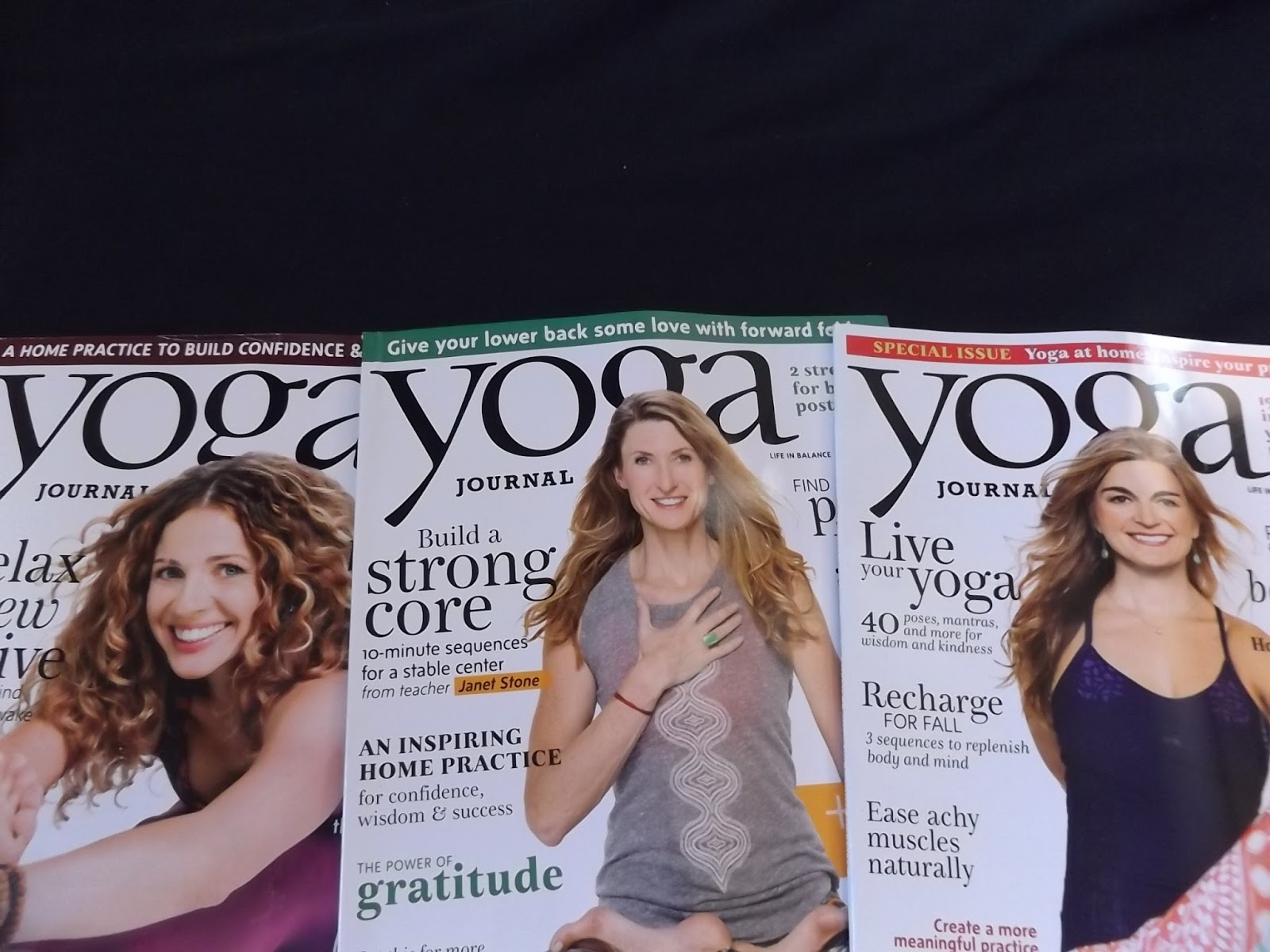
I bought these items for myself, but the yoga magazines, Dr. Bronner's hand sanitizing spray and lavender soap would also make great "stocking stuffers".